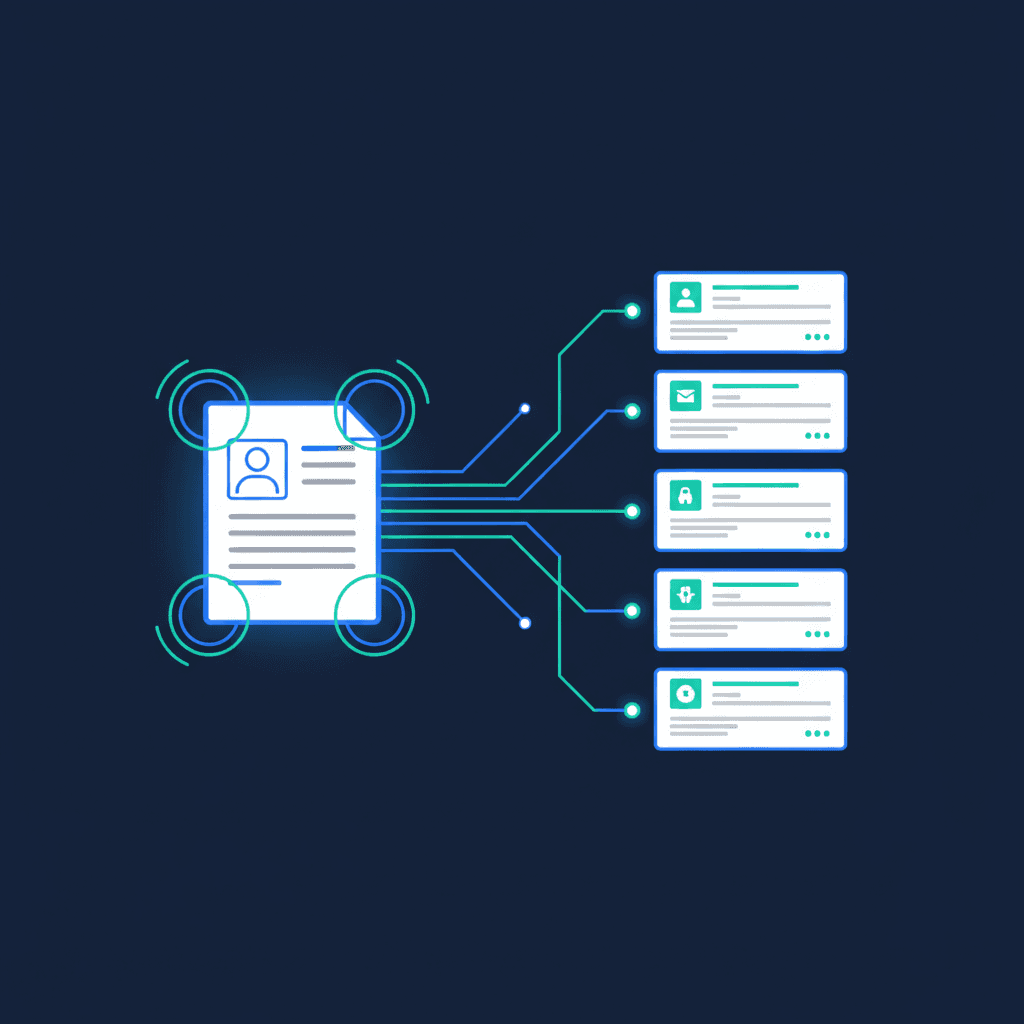
AI Job Matching Explained: How It Works
AI job matching is mostly invisible to the developer using it: you upload a CV, you get a sorted feed. This article opens the box. We cover how embeddings turn job descriptions into vectors, how scoring weighs skills against experience and salary, where the matching gets it right, and where it still gets it wrong.
AI job matching explained: how it works
If you've used a modern remote job platform recently, you've probably noticed something different about the feed. Instead of a chronological list of postings, the roles arrive in some kind of order. Some have little match scores next to them. The platform claims it's matching you based on your CV.
This is AI job matching. It's quietly become the default on better remote job sites, and most developers using it have no clear sense of what's actually happening between the upload of their CV and the ranked feed they get back.
Let's open the box.
What "AI job matching" actually means
In plain terms: AI job matching takes a job description on one side, your CV on the other, and produces a number that estimates how well you fit the role. Then it sorts your feed by that number, so the most promising roles surface first.
That's the headline. The interesting work is in how it gets to that number.
There's no single algorithm. Different platforms use different stacks. But most modern systems share a similar pattern: parse the inputs into structured data, embed the language portions into vector representations, run a scoring function across multiple dimensions, and rank the results.
If that sounds like overkill for sorting job listings, consider what the old approach was: keyword search. You'd type "react remote senior" and the system would surface every listing that contained those three words in any order, regardless of whether the role actually fit you. Half the results would be off by a country, half by seniority, and most by stack depth. AI matching is the response to how badly that worked.
Step 1: parsing the CV
Before any matching can happen, the platform has to understand your CV. PDFs are notoriously hostile to parsers because they're laid out for printers, not databases. A two-column CV looks fine on screen but turns into scrambled word order when extracted.
A decent parsing pipeline handles this in stages. First, layout analysis figures out the reading order. Then named entity recognition picks out the structured pieces: job titles, company names, dates, technologies, education. A language model fills the gaps where the structure isn't obvious.
What comes out the other end is a profile: a set of skills tagged with proficiency hints, a chronology of past roles, a seniority estimate, and any preferences you've added (salary minimum, time zone, willingness to relocate).
This is also where most platforms quietly fail. If your CV is image-heavy, uses unusual fonts, or relies on a creative layout, the parser misses things. The skills section gets truncated. The years-of-experience math comes out wrong. Whatever the matching score does next is built on that incomplete profile, so your feed never quite reflects who you are. Worth checking your parsed profile on any platform that exposes it.
Step 2: parsing the job description
The same process runs on every job posting in the database. Requirements get extracted, the stack gets identified, the seniority band gets inferred from the title and the years of experience requested. Salary ranges get parsed if they're listed.
The interesting case is when the listing is vague. "Strong communication skills" doesn't map cleanly to anything. Neither does "passionate about clean code." A good parser knows to weight these soft signals lower and lean on the concrete requirements. A bad parser treats every line equally and you end up with weird matches based on filler text.
This is also where the platform's data quality compounds. If they're crawling 21,000 company career pages directly, the listings are clean and structured. If they're scraping aggregators that themselves scraped from somewhere else, the data is already three games of telephone away from the source, and the parser is working with corrupted inputs.
Step 3: embeddings, in plain English
This is the part that often gets handwaved. An embedding is a way to represent text as a list of numbers, where similar text produces similar numbers.
The intuition: words like "engineer" and "developer" sit close together in this number-space. So do "Senior" and "Lead." So do "Stripe" and "Adyen." Run a sentence through an embedding model and you get a vector that summarizes its meaning. Compare two vectors using a distance function and you get a measure of how related the two sentences are.
For job matching, the platform embeds your skills, your role history, and the job description into the same vector space. Then it measures the distance. A job description that talks about distributed systems and Go and observability will land close to a CV that mentions those things, even if the exact words differ.
This is why "Senior Backend Engineer" can match to a "Staff Engineer, Platform Infrastructure" posting. Keyword search would miss that completely. Embeddings catch it because the underlying concepts overlap.
LinkedIn's engineering blog published a write-up on their matching infrastructure showing that switching from keyword retrieval to embedding-based retrieval produced double-digit improvements in candidate relevance. The pattern shows up everywhere this has been measured.
Step 4: the scoring function
Embeddings get you a similarity number. But raw similarity isn't enough to rank roles for an actual job hunt. You also care about whether the salary clears your minimum, whether the time zone works, whether the seniority is right, whether the visa requirements rule you out.
So the score is a weighted combination of multiple signals. A typical split looks something like this:
- Skills overlap: how many of the required and preferred skills appear in your CV with credible context
- Experience fit: whether your years and domain match the role's level
- Salary alignment: whether the listed range meets your minimum (and isn't laughably above your current band, which can also be a mismatch signal)
- Location and time zone: hard filters first, soft preferences after
- Stack and culture proxies: tools, methodologies, company size patterns
The weights are tuned. Skills tend to weigh most because they're the most explicit and the most measurable. Salary is a hard threshold below a certain ratio. Location is often binary for visa reasons. Culture is fuzzy and usually weighted low.
The output is a single 0-to-100 number per role. Above 85 means strong fit, 70 to 84 means worth applying with light tailoring, below 70 means probably skip.
Step 5: ranking and explanation
Once every role in the feed has a score, the platform sorts. But a sorted feed without explanation is a black box. Better platforms surface why a score is what it is: which skills matched, which were missing, where you under- or over-qualify, what the salary gap is.
This matters for two reasons. First, it teaches you which roles to tailor your CV for. Second, it builds trust. A 78 score without context feels arbitrary. A 78 score that says "you match 7 of 9 required skills but the company wants 5 years of Kubernetes and you have 2" feels useful.
The Hired State of Software Engineers report has noted that engineers consistently rank "understanding why they were rejected or matched" as one of the top features they want from job platforms. Most platforms ignore this.
Where AI matching actually helps
Three places, mostly.
First, it surfaces roles you'd never search for. A backend developer with infrastructure experience often gets strong matches in Platform Engineering, DevOps, and SRE roles that they'd never type into a search bar. The matching catches the adjacency you missed.
Second, it filters out obvious mismatches before you see them. You don't waste a click on a role that requires senior Rust experience when you have none. Or on a US-only role when you're in Singapore. The bottom of the feed gets quieter, which is usually what you want.
Third, it makes your time work harder. The Stack Overflow Developer Survey has shown for years that developers spend disproportionate time on the search-and-filter phase of job hunting. AI matching compresses that phase by doing more of the filtering upfront.
Where it still fails
It's not magic.
Stale CV problem: if your CV doesn't mention a skill you've been using for two years, the matching can't credit it. Updating your CV bumps every score that depended on that skill.
Vague JD problem: if the company writes a fuzzy job description, the parser can't extract clean signals, and you get a low-confidence score that looks low when the role might actually fit.
Calibration drift: scores can be inflated or deflated depending on how the platform tuned them. A 90 on one site might be a 75 on another for the same CV and the same JD. Don't compare absolute numbers across platforms.
Bias: matching trained on past hiring data inherits the patterns of past hiring, good and bad. Reputable platforms audit for this. Worth asking about.
Five tips for better matches
-
Keep the skills section explicit. Don't bury the stack in prose. List the tools, languages, frameworks, and methodologies you actually use, with rough year counts.
-
Put quantified outcomes in your bullets. "Cut p95 latency from 3.2s to 0.8s across 6 services" gives the parser more to work with than "Improved performance."
-
State your preferences honestly. If you won't take below $120k, set the minimum. If you need EU time zones, set it. The matcher uses these as hard filters, so vagueness costs you.
-
Edit your CV when it changes. A new role, a new language, a new stack. The score is only as fresh as the profile.
-
Trust the band, not the exact number. A 92 vs an 89 isn't a meaningful gap. A 90 vs a 65 is. Apply to the strong fits, ignore the weak ones, and don't agonize over the middle.
How Remote Genie AI does this
Remote Genie AI crawls over 21,000 company career pages directly and surfaces around 2,000 fresh remote roles every day. When you upload your CV, it parses your profile and scores every active role in the feed against you across skills, experience, salary, location, and stack signals.
The score on each card tells you how strong the fit is at a glance. Click through and you see the breakdown: which skills matched, which were missing, where you over- or under-qualify. Edit your CV and the entire feed re-scores within a second.
There's no auto-apply, no recruiter middleman, no inflated keyword game. Every link goes straight to the company's careers page so you can apply on their ATS directly.
Wrapping up
AI job matching isn't a marketing label. It's a real change in how job feeds get sorted, and on a good platform it saves you hours of scrolling per week. The trick is understanding that the score is only as good as the data going in, on both sides. Clean CV, clean job description, calibrated weights: you get a feed worth reading. Any of those missing: garbage in, garbage out.
If you want to see what a real AI-matched feed looks like for your stack, upload your CV and see what surfaces. Most developers find at least one role in the top ten they wouldn't have searched for themselves.
Frequently Asked Questions
Ready to find your next remote job faster?
Remote Genie AI matches 2,000+ remote jobs to your CV daily. Direct links, no middlemen.
Get Full Access