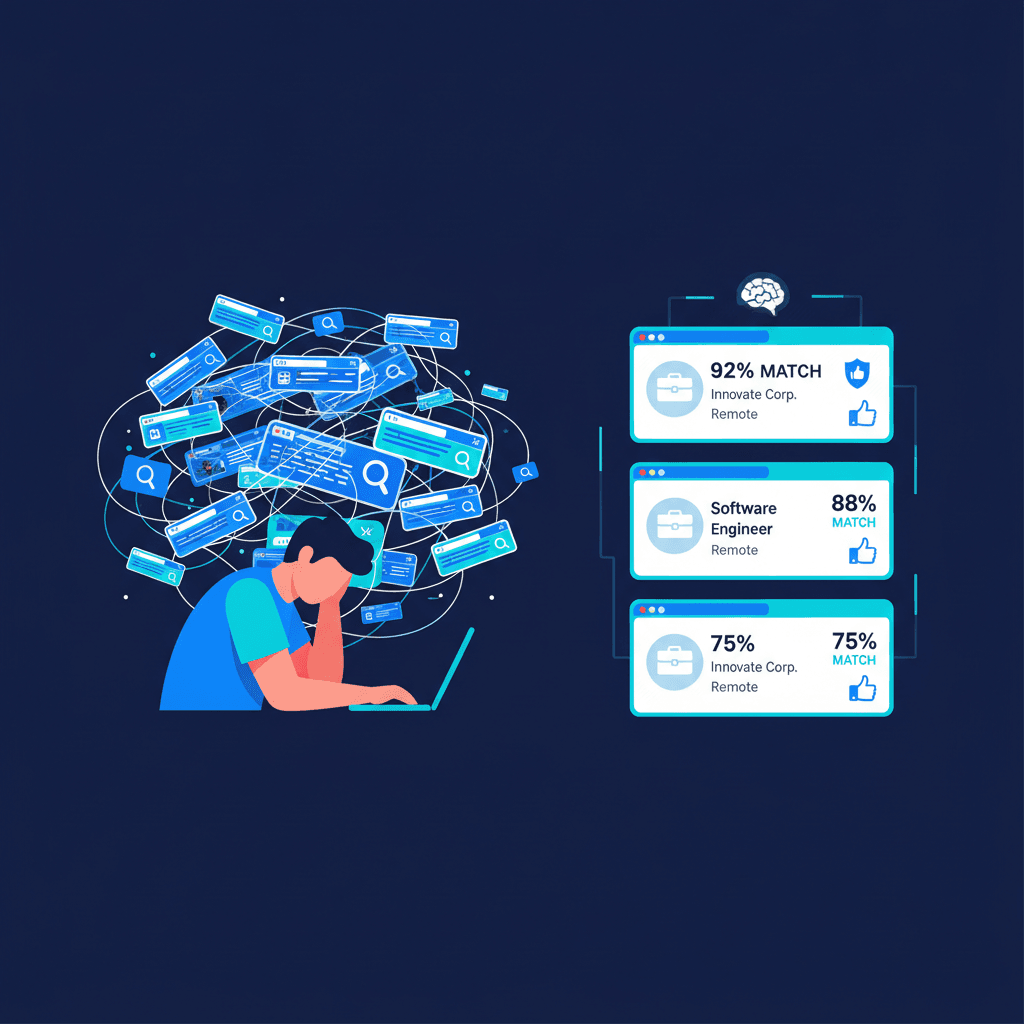
Stop Scrolling Job Boards — Let AI Match Jobs to Your CV
Most developers spend hours a week scrolling job boards, opening listings, scanning requirements, and bouncing. The math is brutal: for every role worth applying to, you'll skim 20 that aren't. AI-matched feeds invert this by ranking roles by CV fit first, so the top of your feed is already worth your time.
Stop scrolling job boards — let AI match jobs to your CV
There's a specific kind of tab fatigue developers know well. You open a job board on a Tuesday evening. You skim listings, open promising ones in new tabs. Twenty minutes later you have eleven tabs open, ten of which turn out to be wrong about something: hybrid masquerading as remote, senior title with mid pay, "full-stack" meaning ten technologies on one head, or just the wrong country entirely.
You close the tabs. You go to bed. You repeat the process Wednesday.
This is the default state of developer job hunting, and it's wildly inefficient. The Stack Overflow Developer Survey has shown for several years that developers ranked time spent on the search-and-filter step as one of their top job-hunt frustrations. The platforms haven't gotten better at fixing it. They've gotten better at monetizing the time you spend there.
AI job matching is the response to this. Instead of sorting jobs by recency or by who paid for promotion, the feed sorts by how well each role fits your CV. The top of the list is already the part worth your attention.
The arithmetic of scrolling
Let's put real numbers on it.
A typical developer job hunt involves applying to somewhere between 30 and 80 roles before landing an offer, according to surveys from Hired and others. To find those 30 to 80 roles worth applying to, the same developer skims roughly 15 to 25 listings per role applied to. So the funnel looks like: scroll past 600 to 2,000 listings, open 300 to 600, apply to 30 to 80.
The time cost is real. Even at 30 seconds per listing read, you're spending five to fifteen hours just on the filter stage. That's a full working week, spread across evenings, just figuring out which roles to bother with.
The cost compounds in another way: by the time you finish reading the listings, the freshest roles are no longer fresh. Good remote roles often fill within 72 hours of posting. If you're spending Tuesday evening scrolling listings posted last week, the strongest fits may already be gone.
What changes with AI matching
The model is simple. You give the platform your CV once. From then on, every job listing it ingests gets scored against you. When you open the feed, the top result is the best fit for your CV in the entire database. The second result is the second best. And so on.
You stop spending time deciding whether a role might fit. You spend time deciding whether to apply to the roles that already do.
That sounds small. It's not. Compressing the filter stage from five-to-fifteen hours into one-to-two hours per week is the biggest unlock in modern job hunting. Every other improvement — better CV, better cover letter, better company research — gets multiplied by having more time to do it.
Why scrolling stays sticky
If AI matching is so clearly better, why are developers still scrolling traditional boards?
Habit. The big boards (LinkedIn, Indeed) are where developers have always looked. Switching to a new tool feels like extra work, even when the new tool saves more time than it costs.
Distrust. Some developers have tried matching tools that gave bad results because the underlying database was small or stale. A bad first experience kills the category for them.
Curiosity. Some developers like browsing. There's a small joy in stumbling on a company you'd never heard of doing something interesting. Pure ranking can feel like it removes the serendipity.
Scope worry. Developers worry that a ranked feed will hide good roles that the matcher scored low for the wrong reason. This is the real concern, and the answer is to use ranking as a strong default but not the only view.
The compounding gains
Here's what actually happens when developers switch to AI-matched feeds, based on observed patterns across remote-focused platforms:
You apply faster. When the top of your feed is already strong fits, you skip the read-everything phase and go straight to the apply-to-the-good-ones phase. Applications go out within 24 hours of posting instead of within a week.
You apply to better roles. "Better" meaning roles you actually want and could land. Less time spent on stretch roles you'll never hear back from. More time on solid matches where you have a real shot.
You discover adjacent paths. This is the underrated one. A backend engineer who can ship product surfaces strong matches in Platform Engineering, DevOps, and infrastructure roles they'd never have searched for. The matcher catches adjacency that keyword search hides.
You stop second-guessing. A score makes the application decision faster. You don't reread the description three times wondering if you should apply. The number says it's an 87 and you can see why. Apply or don't.
What "let AI match" actually requires from you
Three things.
A current CV. Not a 2019 version with your last job missing. The matcher reads what you give it. Out-of-date inputs produce out-of-date matches.
Clear preferences. Salary minimum, time zone, location restrictions, contract vs full-time. The matcher uses these as filters before scoring. Vague preferences waste matching capacity on roles you'd never take.
Light feedback. Most platforms learn from what you click and ignore. So clicking a role you actually like signals that you want more like it. Ignoring weak matches signals the opposite. A week of normal use calibrates the feed.
That's it. There's no hour-long onboarding, no skill quiz, no personality profile. The CV does most of the work.
How to know the matching is working
The signal is the feed. If the top 10 results in your AI-matched feed look more compelling than the top 10 results from a manual keyword search, the matching is working. If they don't, either your CV is incomplete, your preferences are missing, or the platform's database isn't deep enough.
A good gut check: after a week, you should be able to look at your feed and think "yeah, three of these I'd actually apply to" without having to read the full description. If you're still wading through obvious mismatches, the platform isn't pulling its weight.
The Buffer State of Remote Work report has noted that developer satisfaction with remote job search tools correlates strongly with how curated the inbound feed feels. Curation isn't the absence of options. It's the relevance of the first ten.
What you don't lose
A few worries developers raise about switching to AI-matched feeds, and the honest answers.
You don't lose the ability to browse. Most platforms offer both a ranked feed and a filter-based search. Use ranking as the default, search when you have a specific company in mind.
You don't lose discovery. The ranked feed actually surfaces more discovery, not less, because it catches adjacent roles you'd never have typed into a search bar.
You don't lose control over what you apply to. The score is a recommendation. You still decide whether to click apply. Nothing is automatic.
You don't lose privacy. Reputable platforms keep your CV private until you actively apply through them. Your data isn't shared with employers automatically.
Five habits for developers who switch
-
Set salary and location once, properly. This is the most common mistake. Vague preferences waste matching capacity. Be specific.
-
Refresh your CV every two months even if nothing changed. It forces you to add the small things you've been doing. Those small things bump your scores.
-
Read the breakdown, not just the number. A 78 with a clear story is more useful than a 92 you don't understand.
-
Apply within 24 hours of seeing a strong match. Remote roles fill fast. The first hundred applicants get the recruiter attention; the next thousand get the auto-reject.
-
Track outcomes. When you apply, log it. Patterns emerge: certain company types respond, others don't. Adjust which scores you trust based on what actually leads to interviews.
How Remote Genie AI works
Remote Genie AI crawls more than 21,000 company career pages directly and surfaces around 2,000 fresh remote roles every day. When you upload your CV, every active role in the database gets scored against your profile across skills, experience, salary, location, and stack signals.
The top of your feed is the best fit in the entire database. Each card shows the score and a breakdown of why the score is what it is. The links go straight to the company's careers page, with no auto-apply layer between you and the recruiter.
A Kanban tracker is built in, so the roles you decide to apply to don't get lost in the same scroll-and-forget pattern that boards encourage. Save → Applied → Interview → Offer, all in one view.
Conclusion
The scroll-and-skim approach to remote job hunting works, in the sense that it eventually produces offers. But it works at a cost: hours per week, on top of the actual application work. AI-matched feeds remove most of that cost. You get a ranked list of fits, with explanations, that updates the moment your CV does.
The first time it works for you, you stop wondering why you used to scroll. Try it on a real feed: upload your CV and see what the top ten looks like for your stack and stage. If the top results are sharper than what you'd find by manual search, you've found your new default.
Frequently Asked Questions
Ready to find your next remote job faster?
Remote Genie AI matches 2,000+ remote jobs to your CV daily. Direct links, no middlemen.
Get Full Access