AI vs Traditional Job Boards: Which Finds Better Jobs?
Job boards and AI matching platforms look similar on the surface, but they're built on different incentives and different data. This comparison walks through where each model wins: coverage, freshness, ranking quality, and what actually happens after you apply.
AI vs traditional job boards: which finds better jobs?
Ask a developer how the job search is going and you'll usually hear a version of the same complaint: hours of scrolling, hundreds of listings, and maybe three roles that were worth reading twice. Then ask which tools they're using. The answer is almost always a list of traditional job boards.
That's not a coincidence. The frustration and the tooling are connected. Traditional boards were designed around a business model that predates modern matching technology, and that model shapes everything about the results you see. AI-based platforms start from a different premise, and the difference shows up in day-to-day search quality.
This article compares the two models honestly. Not "old thing bad, new thing good," but a look at what each one is structurally built to do, where each wins, and how to combine them if you're actively looking.
What a traditional job board actually is
A job board is a marketplace with two customers, and you're the one who doesn't pay.
Employers pay to post listings, promote them, and access candidate databases. That revenue model has consequences for what you see as a job seeker:
The inventory is whatever employers paid to list. A company that didn't buy a posting on that particular board is invisible to you there, no matter how good the fit. Coverage across boards is fragmented, which is why serious job seekers end up with five tabs open.
Sorting favors the paying side. Promoted listings sit at the top. Below that, results are usually ordered by posting date or loose keyword relevance. Nothing in the ranking asks "is this a good role for this specific person?"
Listings go stale. An employer posts a role, fills it in three weeks, and the listing stays up for another two months because nobody is paid to take it down. A 2024 analysis covered by the Wall Street Journal found that a substantial share of online listings were "ghost jobs" that companies had no near-term intention of filling. Every one of those costs you reading time.
None of this makes boards useless. It makes them what they are: a paid-placement directory with a search box.
What an AI job platform actually is
An AI matching platform inverts the model in two ways.
First, sourcing. Instead of waiting for employers to pay for placement, aggregation-based platforms crawl company career pages directly. The inventory is "what companies are actually hiring for right now," not "what companies paid this specific board to show." Remote Genie AI, for example, scans more than 21,000 company career pages daily and surfaces around 2,000 active remote positions from them.
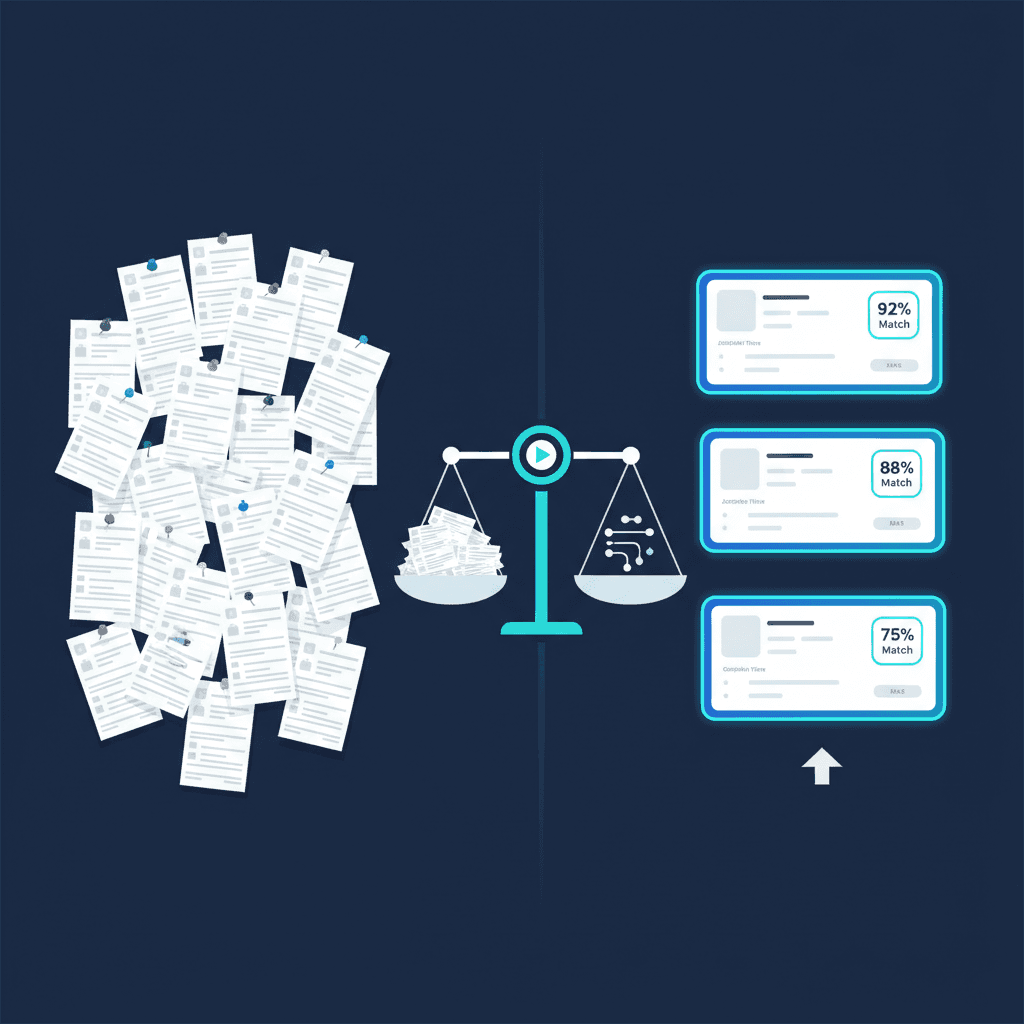
Second, ranking. Instead of sorting by date or promotion budget, the platform reads your CV and scores every listing against it. Stack overlap, seniority, domain experience, the kind of companies you've worked at. The feed you see is ordered by fit, with the best matches at the top.
That second point is the practical difference you feel immediately. On a board, the burden of filtering is on you. On a matching platform, the burden is on the ranking model, and your job is to review its top results rather than dig for them.
Where traditional boards still win
An honest comparison has to give boards their due, because they win in specific situations.
Direct company targeting. If you want to work at one particular company, its careers page or its posting on a major board is the fastest route. No ranking model needed.
Niche communities. Specialized boards for a language ecosystem or an industry sometimes carry roles that are shared inside a community before they're posted anywhere else. A small Elixir jobs board can beat any general platform for Elixir roles for exactly this reason.
Brand-name gravity. Large boards attract listings from companies that only post in one or two places. If a company's entire hiring pipeline runs through one big platform, that's where the listing lives.
Notice the pattern: boards win when you already know what you're looking for. They lose when the task is discovery, which is what most of a job search actually is.
Where AI platforms win
Discovery across title variations. The same senior backend role gets posted as Staff Engineer, Lead Software Engineer, or Senior Platform Engineer depending on the company. A keyword search treats those as different jobs. A CV-based ranking model scores them all against your experience and surfaces the ones that fit, whatever they're called.
Freshness. Platforms that re-crawl career pages daily notice when a listing disappears from the source and drop it. That doesn't eliminate stale listings entirely, but it beats the post-and-forget lifecycle of paid boards.
Signal-to-noise ratio. This is the big one. According to the Hired State of Software Engineers report, developers consistently rank "irrelevant job recommendations" among their top frustrations with the hiring process. Ranking by fit attacks that problem directly. When the top 20 results in your feed are the 20 best matches out of thousands, you spend your reading time on listings that deserve it.
Compounding personalization. Boards reset to zero every session. A matching platform learns from your CV once and applies that understanding to every new listing that appears. The Stack Overflow Developer Survey has shown for years that most developers are open to opportunities but not actively looking. A ranked feed suits that mode well: check in twice a week, review the top matches, done.
The part nobody measures: what happens after you apply
Search quality isn't just about what you find. It's about what converts.
Applying through a big board often means entering a pile of hundreds of applications, many from people who clicked "easy apply" without reading the listing. Recruiters respond to that volume by skimming harder and leaning more on automated screening.
Applying to a role you found because it genuinely matches your CV changes the odds. Your application actually addresses what the role needs, your cover letter can point at real overlap, and you're less likely to be filtered out for an obvious mismatch. Fewer, better-targeted applications routinely beat spray-and-pray. The fit-first workflow makes that strategy the default rather than a discipline you have to maintain.
One search, two tools: a concrete comparison
Abstract arguments about incentives are easy to nod along to, so here's the same search run both ways.
The candidate: a backend engineer, six years in, mostly Go and PostgreSQL, some Kubernetes, looking for a senior remote role in a European time zone.
On a traditional board, the session starts with a query. "Senior backend engineer remote" returns a few hundred results. The first screen is promoted listings, two of which are from recruiting agencies reposting roles that exist elsewhere. Sorting by date helps with staleness but pushes well-fitting older listings out of sight. Titles like "Staff Engineer, Infrastructure" never appear because the query said "backend." After forty minutes the engineer has opened maybe 25 tabs, closed 20, and saved 3 roles, one of which turns out to have been filled a month ago.
On a matching platform, there is no query. The feed opens already ranked against the uploaded CV. The top listing is a "Senior Platform Engineer" role at a logistics company, heavy on Go and Postgres, salary listed, crawled from the company's own careers page that morning. It would never have matched the keyword search. The engineer reviews the top 15 scored matches in about twenty minutes and saves 4, each with visible reasoning about why it ranked where it did.
Same market, same candidate, same evening. The difference is which side did the filtering work, and how much of the market each approach actually touched. The keyword session sampled a few hundred listings from one board's paid inventory. The ranked session drew on every listing the crawler found across thousands of career pages, because the model reads all of them and the engineer doesn't have to.
How to combine both models
If you're actively searching, here's a setup that uses each tool for what it's good at:
- Make an AI-ranked feed your daily driver. Upload your CV once and let the ranking do the first pass over the full market. Review top matches a few times a week instead of scrolling raw listings daily.
- Keep one niche board if your ecosystem has a good one. Language-specific and industry-specific boards carry community roles worth checking weekly, not daily.
- Go direct for target companies. Keep a short list of companies you'd join tomorrow and check their career pages monthly. No middleman needed.
- Ignore promoted placement everywhere. A listing at the top of a board's results is there because someone paid. Treat position on a board as zero signal about fit.
- Check listing freshness before investing time. If a platform shows when a role was last verified against the source, use that. A listing that vanished from the company's own careers page is not worth a cover letter.
- Track everything in one place. Whichever mix of sources you use, pipe applications into a single tracker so follow-ups don't fall through the cracks.
- Let results reallocate your time. After a month, look at where your interviews actually came from. Most people are surprised by how lopsided the answer is, and the lopsided answer is where your hours should go.
How Remote Genie AI fits into this
Remote Genie AI is built on the aggregation-plus-ranking model this article describes. It crawls 21,000+ company career pages daily, which sidesteps the pay-to-post inventory problem, and keeps around 2,000 active remote positions live at any time. You upload your CV, and every listing is scored against it, so your feed opens with the roles most worth your attention rather than the ones posted most recently.
The surrounding workflow covers the rest of the search: filters for stack, seniority, and salary when you want to narrow things down manually, a Kanban tracker for the applications you start, and a cover letter generator that works from the specific job description plus your actual CV. The company directory is there for the direct-targeting strategy, letting you browse who's hiring remotely and check their open roles in one place.
It doesn't replace the niche community board for your favorite language. It replaces the five general-purpose tabs you're scrolling out of habit.
Conclusion
Traditional job boards and AI matching platforms aren't two versions of the same tool. They're different machines built on different incentives. Boards monetize employer placement and hand you a search box to sort out the rest. AI platforms aggregate the market and rank it by fit, which moves the filtering work from your evenings onto the model.
For targeted moves at known companies, boards and career pages still do the job. For the discovery phase, which is most of the search, ranked-by-fit is simply a better default.
If you want to see what your own feed looks like ranked against your CV, get started with Remote Genie AI. Upload a CV, and the first screen you see is the comparison this article just described, running on your own data.
Frequently Asked Questions
Ready to find your next remote job faster?
Remote Genie AI matches 2,000+ remote jobs to your CV daily. Direct links, no middlemen.
Get Full Access